Abstract
Human motion synthesis is an important task in computer graphics and computer vision. While focusing on various conditioning signals such as text, action class, or audio to guide the generation process, most existing methods utilize skeleton-based pose representation, requiring additional skinning to produce renderable meshes. Given that human motion is a complex interplay of bones, joints, and muscles, considering solely the skeleton for generation may neglect their inherent interdependency, which can limit the variability and precision of the generated results. To address this issue, we propose a Shape-conditioned Motion Diffusion model (SMD), which enables the generation of motion sequences directly in mesh format, conditioned on a specified target mesh. In SMD, the input meshes are transformed into spectral coefficients using graph Laplacian, to efficiently represent meshes. Subsequently, we propose a Spectral-Temporal Autoencoder (STAE) to leverage cross-temporal dependencies within the spectral domain. Extensive experimental evaluations show that SMD not only produces vivid and realistic motions but also achieves competitive performance in text-to-motion and action-to-motion tasks when compared to state-of-the-art methods.
Method
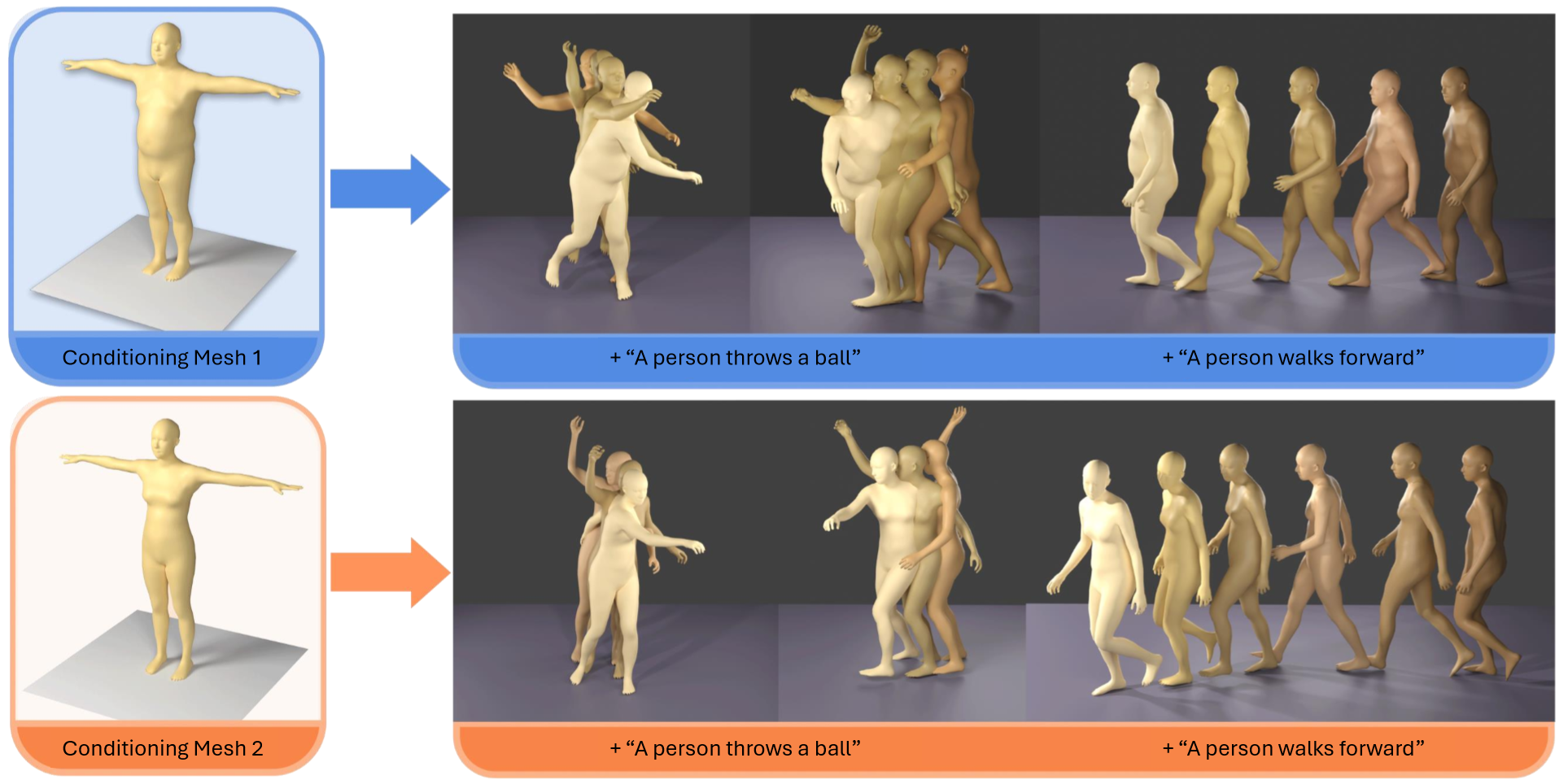
Given a target body mesh and a text or action prompt, SMD synthesizes a motion sequence directly in mesh format, keeping the body shape consistent across all frames.
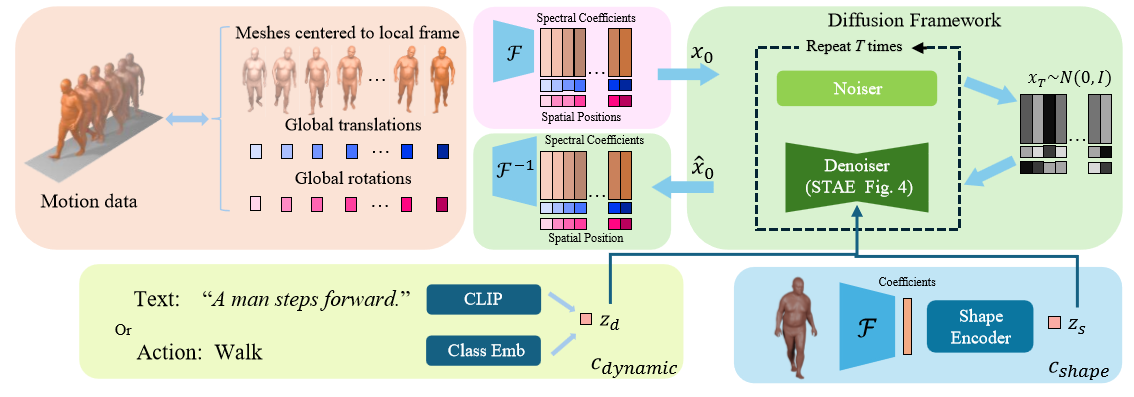
Method overview: input meshes are encoded into spectral coefficients via the graph Laplacian, and a diffusion model generates motion in this compact spectral domain.
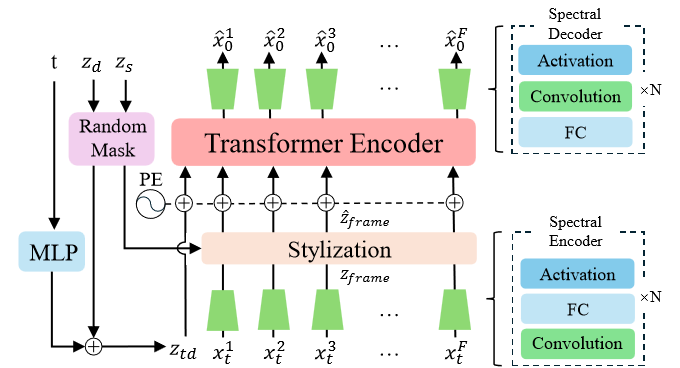
The Spectral-Temporal Autoencoder (STAE) captures cross-temporal dependencies within the spectral domain to produce coherent mesh motion.
Quantitative Results
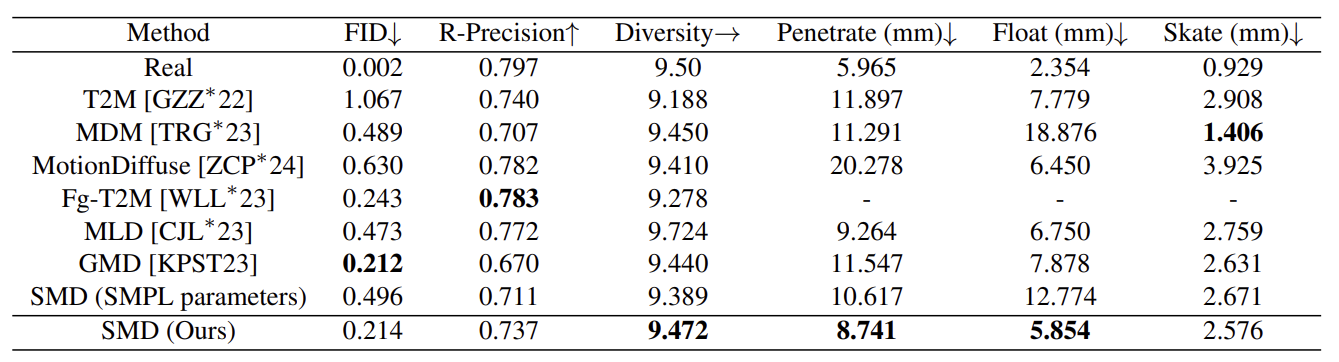
Text-to-motion evaluation on HumanML3D. Beyond the standard FID, R-Precision and Diversity metrics, we report physical-plausibility measures — ground penetration, floating and foot skating. SMD achieves the best Diversity, Penetrate and Float scores and competitive FID, demonstrating that generating motion directly in mesh format yields more physically plausible results than skeleton-based baselines.
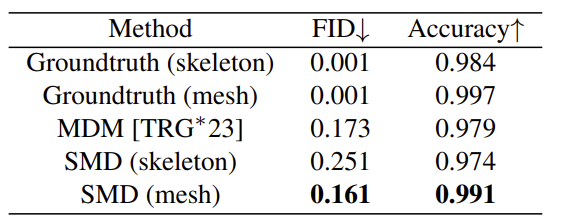
Action-to-motion evaluation. Compared against the ground truth and MDM, our mesh-based variant SMD (mesh) obtains the best FID and Accuracy, outperforming its skeleton-based counterpart and confirming the benefit of the mesh representation for recognizable, high-fidelity action generation.
BibTeX
@article{xue2025shape,
  title={Shape-Conditioned Human Motion Diffusion Model with Mesh Representation},
  author={Xue, Kebing and Seo, Hyewon and Bobenrieth, C{\'e}dric and Luo, Guoliang},
  journal={Computer Graphics Forum},
  year={2025},
  doi={10.1111/cgf.70065},
  publisher={Wiley}
}